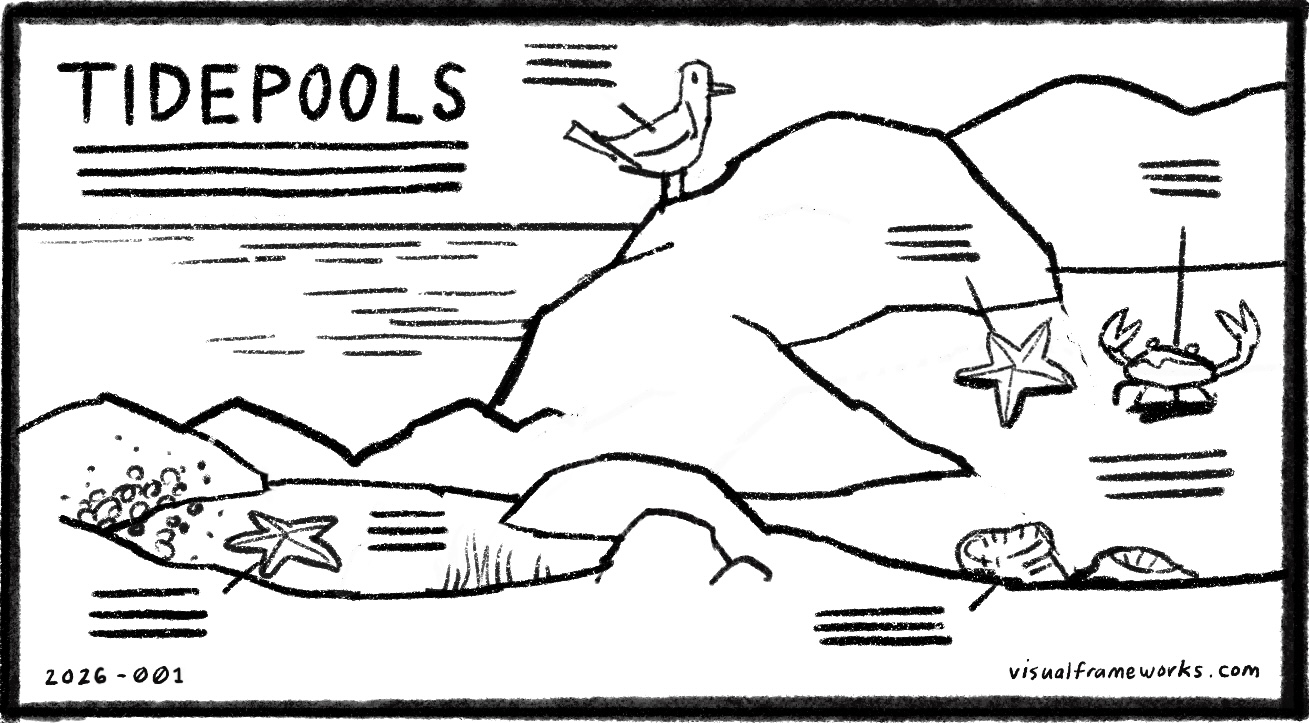
A tidepool is a small basin of seawater left in the rocks when the tide goes out. Sealed from the ocean for hours at a time, it holds its own population of anemones, urchins, hermit crabs, and algae. A complete world in miniature. When the tide returns, it floods the basin with fresh seawater, new nutrients, and the occasional new organism, then withdraws again.
What makes a tidepool generative is the rhythm of that alternation. The isolation isn’t deprivation; it’s the condition for a particular kind of life. Organisms adapt to the concentrated, bounded, still environment that the open ocean never provides. The periodic influx doesn’t disrupt that adaptation; it replenishes it. Biologists have long used tidepools as natural laboratories precisely because the boundary conditions make dynamics visible that the open water obscures. The edge between land and sea, cycling between exposure and immersion, turns out to be one of the most fertile environments on earth.
Are you in a period of isolation or influx, and what does this moment call for? What has the bounded condition of your current situation made possible that the open current wouldn’t? What has the last tide brought in that you haven’t examined yet? Is the enclosure you’re working within a constraint or a laboratory? When the tide returns, what do you want it to find?
See also: Lunar cycle, Sedimentary layers, Water cycle, Tipping point, Seasons, Pendulum, Hole, Infinite loop, Growth, Flywheel, Virtuous Cycle, Cycle.
2026–001