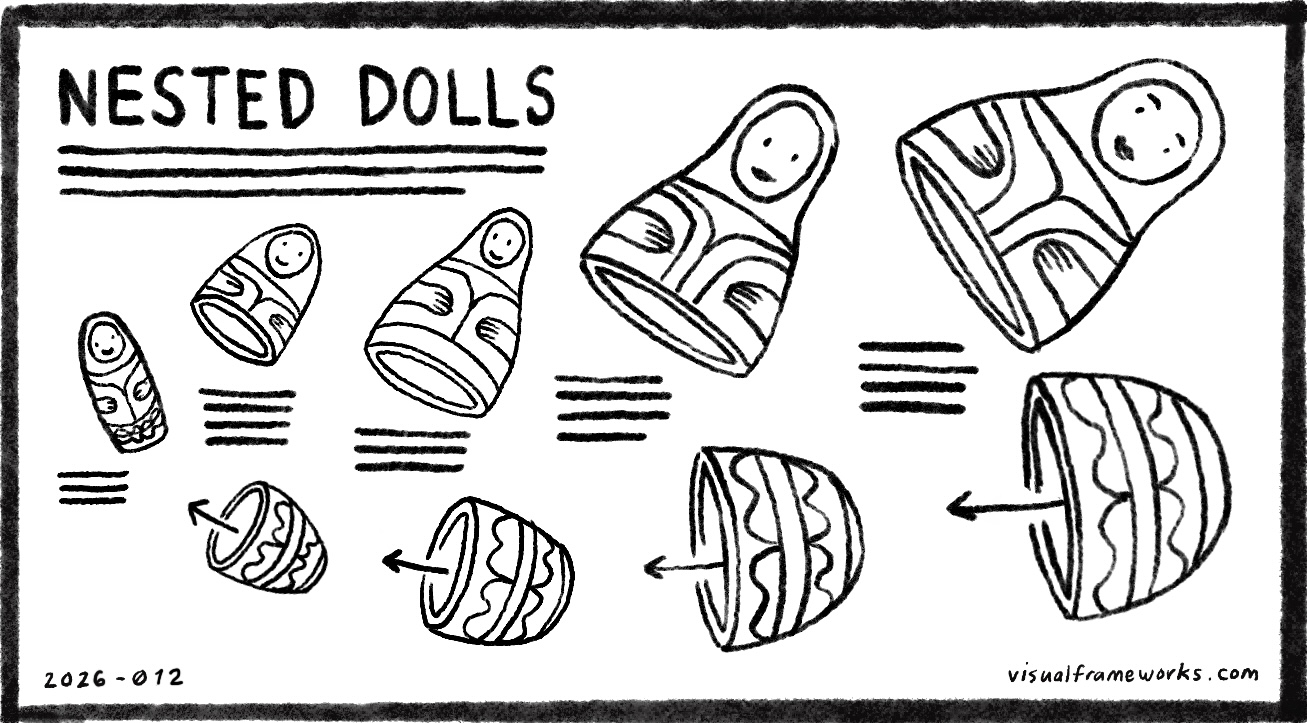
A set of nested dolls looks complete from the outside. Pick one up and it has weight, a painted face, a finished form. Twist it open and there is another doll inside, just as complete, just as self-contained. Then another. The dolls nest perfectly because each one is a whole thing and also a shell around a smaller whole. The smallest holds nothing.
Many situations have this structure: a problem inside a problem, a system inside a system, a story inside a story. Each layer presents itself as the full picture until you open it. The outermost version is real, but partial. Working inward doesn’t invalidate what you found at the surface; it shows you what the surface was containing. The question is how many layers there are, which one you’re actually trying to understand, and whether you’ve reached the one that matters.
What layer are you working with? Is it the right one? What might opening the current frame reveal? Have you reached the center, or does it only look like the center from here? Is the outer form a complete thing in itself, or is it primarily a container? When you find the smallest layer, what does it tell you about all the ones that held it?
See also: Fractal, Peeling the onion, Zoom in/out, Layer cake, Sedimentary layers, Iceberg, Cutaway view, Exploded view
2026-012