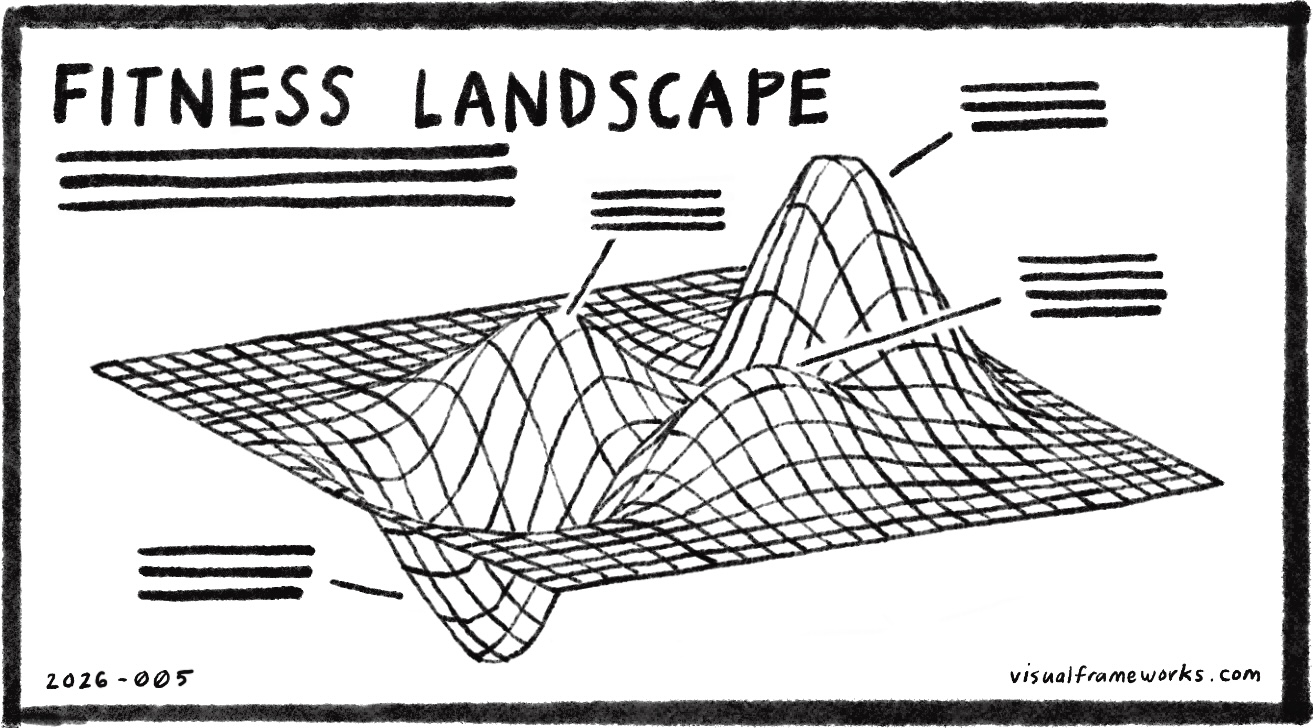
In evolutionary biology, a fitness landscape maps the relationship between genetic variation and survival. Imagine a three-dimensional terrain: peaks represent combinations of traits that help an organism thrive; valleys represent combinations that don’t. Evolution climbs this surface through incremental selection, moving uphill one small step at a time.
The trouble is that every landscape has more than one peak. An organism can spend generations climbing steadily and get stuck at a local summit, where the only path to a taller peak leads first through a valley. Natural selection has no mechanism for voluntary descent. The same dynamic appears anywhere improvement happens incrementally. An organization can optimize its way to the top of the wrong hill. A product can get very good at solving a problem that is about to stop mattering. A career can advance expertly toward somewhere you no longer want to go.
Are you climbing a hill you chose deliberately, or just climbing the one you happen to be on? Is there a different slope you’d rather be climbing? Is there a valley you have been avoiding because it looks like regression? If the landscape has shifted under you recently, are you still navigating by the old map, or do you need a new one?
See also: Mountain climbing, Tipping point, Crossroads, Hole, Bottleneck, Escape velocity, Decision tree.
2026-005